How to Build a Simple AI Agent for Task Automation
Learn practical steps to build a simple AI agent for business task automation in 2026, from basic concepts to real-world implementation.
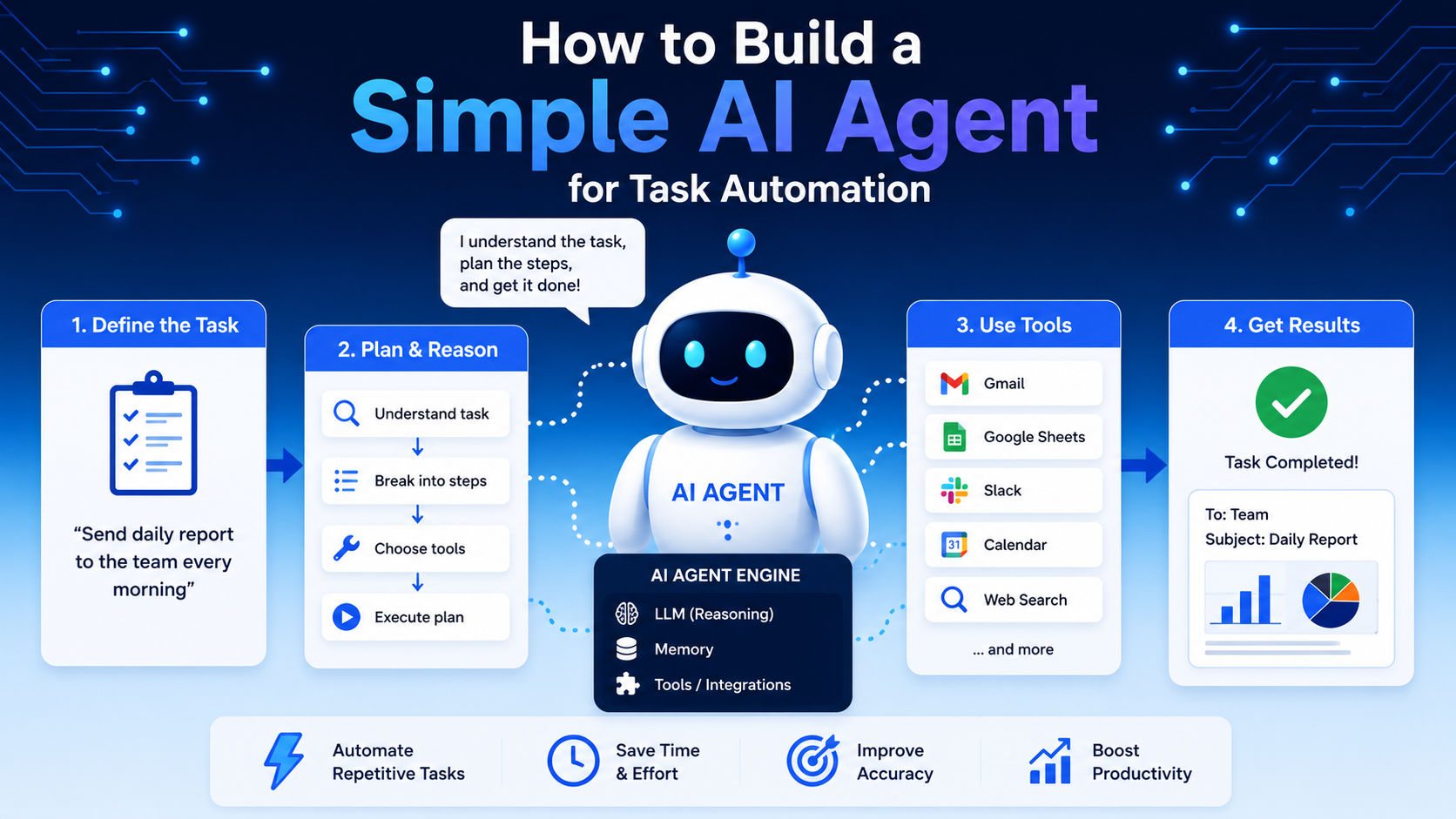
Imagine this: by 2026, more than 70% of mid-sized companies in Southeast Asia have adopted at least one form of AI agent to handle daily operational tasks — from replying to customer emails, managing inventory, to compiling automated financial reports. This figure has nearly tripled compared to two years prior, driven by the falling inference costs of large language models (LLMs) and the proliferation of low-code development platforms that enable non-technical teams to build intelligent agents in hours, not months. Amid this wave of transformation, the most frequently asked question is no longer "is an AI agent possible?" but rather "how can I build one for my business — without having to hire a dedicated team of AI engineers?" The answer turns out to be far simpler than imagined. An AI agent is a natural evolution of chatbots and automation scripts: a system that not only responds to commands but is also capable of planning steps, calling tools, and completing multi-stage tasks independently.
What Is an AI Agent? A System That Works Like a Personal Digital Assistant
If a traditional chatbot is like an answering machine that can only respond to pre-programmed questions, then an AI agent is more like a personal assistant to whom you can give general instructions, and it will break them down into small steps, execute each step, check the results, and make further decisions when necessary. A simple analogy: imagine you hire a new staff member to handle online orders. You don't need to tell them every click to make in the system. You simply say, "Every time an order comes in, check stock, create an invoice, send a confirmation email to the customer, and record it in the spreadsheet." That staff member will understand the workflow, ask when something is ambiguous, and improvise when unexpected situations arise. An AI agent works on the same principle — except it runs 24 hours nonstop without fatigue, without a monthly salary, and can handle thousands of tasks simultaneously.
Architecturally, a simple AI agent in 2026 generally consists of three core components that distinguish it from a mere automation script:
Large language model (LLM) as the brain: Models such as GPT-4o, Claude 4 (released in early 2026), Gemini 2.5, or open-source models like Llama 4 and Qwen 3 serve as the primary decision-maker. These models understand instructions in natural language, plan steps, and determine when to call specific functions.
Tools as the hands and feet: These are functions that the agent can call to interact with the outside world — for example, sending emails via API, reading databases, writing to spreadsheets, performing web searches, or calling other cloud services. By 2026, most major LLM platforms already provide built-in "function calling" or "tool use" features, making integration very easy.
Planning and execution loop as the nervous system: The agent works in a repeated cycle: receiving input → planning steps → calling tools → evaluating results → deciding the next step or completing the task. This pattern is often referred to as a reasoning loop or agentic loop.
The types of AI agents commonly found in 2026 can be grouped into four main categories:
Purely reactive agents: The simplest type that directly maps input to output without storing memory. Suitable for very specific tasks such as email classification or advanced spam filtering.
Rule-based agents with LLM: Combines predetermined business logic (such as approval workflows) with the natural language capabilities of LLMs to understand input variations. This is the type most commonly built by small and medium businesses because the risks are manageable.
Goal-based agents: Given a general target such as "reduce the number of unanswered support tickets below 10 per day" and left to plan its own approach. Increasingly used for social media management and brand monitoring.
Multi-agent systems: Several agents working together, each with a specific role (one writes, one researches, one reviews). By 2026, this architecture is becoming increasingly popular for content production and complex data analysis, but beginners are advised to start with a single agent first.
Why AI Agents Matter: From Static Automation to Intelligent Autonomy
1. Saving Hundreds of Hours of Manual Work Every Month
Traditional automation — such as email rules in Gmail or Excel macros — only works for previously known patterns. As soon as a small variation appears in the input format, the system immediately fails. AI agents change this paradigm with their ability to understand natural language and context. An agent tasked with entering invoice data into an accounting system no longer cares whether the invoice is a scanned PDF, an email with an image attachment, or a long text without clear formatting. It will read, interpret, and enter the data automatically. According to various industry surveys in early 2026, operational teams that adopted AI agents for administrative tasks reported average time savings of 15–25 hours per week per employee — equivalent to nearly one additional month of work each quarter.
Case Study – A mid-sized logistics company in Jakarta: A logistics company with around 200 employees implemented a simple AI agent to manage incoming emails related to shipment status. Previously, five customer service staff spent about four hours per day answering repetitive questions like "where is my package?" and "when will the goods arrive?". After an AI agent with API integration to the tracking system was implemented, questions that could be answered automatically increased to 65%, and the average response time dropped from 45 minutes to under 30 seconds. The remaining staff could be reassigned to handle escalation cases that genuinely require a human touch.
2. Consistency That Humans Cannot Match
Humans get tired, bored, and can forget important steps — especially when workload piles up at the end of the month or near deadlines. AI agents do not have this problem. They will execute the same procedure with high precision at 2 a.m., on national holidays, or while handling a hundred requests at once. This consistency is extremely valuable for tasks that demand compliance with rules, such as customer data validation, document completeness checks, or automated internal audits. In a world increasingly governed by data compliance standards such as Indonesia's PDP Law and various financial sector regulations, a well-designed AI agent actually becomes a tool to reduce the risk of human error.
3. Instant Scalability Without Adding Fixed Costs
As a business grows, the administrative workload often grows faster than the company's ability to hire additional staff. AI agents eliminate this barrier. A single agent implementation can handle five requests per day or five thousand requests per day without significant code changes — all that is needed is additional computing capacity, the cost of which is far lower than recruitment and training costs. By 2026, the cost of running an AI agent based on a self-hosted open-source model can even be below Rp500,000 per month for moderate workloads, making this technology accessible even to micro-enterprises.
4. Freeing Humans for Truly Valuable Work
The most frequently forgotten benefit in discussions about automation is its liberating effect. When AI agents take over repetitive tasks such as data entry, email sorting, meeting scheduling, and routine report generation, human employees can redirect their energy to areas that genuinely require creativity and empathy: building relationships with clients, designing new strategies, solving problems without clear patterns, or simply taking time for more thoughtful decision-making. Ultimately, AI agents are not about replacing humans but about returning humans to the work that deserves to be done by humans.
AI Agent Adoption in Indonesia: From Jakarta Startups to SMEs in the Regions
The AI agent ecosystem in Indonesia in 2026 shows highly dynamic growth, with adoption no longer limited to large corporations or tech startups in Jakarta. The second wave of adoption is actually coming from mid-sized cities such as Surabaya, Bandung, Medan, Makassar, and Yogyakarta, where retail businesses, professional services, and mid-scale manufacturing are starting to build simple agents for their specific needs.
Key Players: From the global side, platforms such as OpenAI with its custom GPTs (which since 2025 have fully supported function calling for non-technical users), Anthropic with Claude and its tool use features, and Google with Gemini and the Google Cloud Vertex AI Agent Builder ecosystem are the primary choices for Indonesian developers. Meanwhile, from the local side, several companies are beginning to offer Indonesian-language AI agent builder platforms designed specifically for domestic market needs — including integration with the most widely used chat applications in Indonesia such as WhatsApp Business and Telegram. Low-code and no-code platforms such as Botpress, Flowise, Dify, and Langflow are also experiencing a surge in users from Indonesia, as they allow small IT teams to build agents with visual interfaces without having to write code from scratch.
Local Success Stories:
A fast-food restaurant chain in Bandung implemented an AI agent to manage incoming orders from three delivery platforms simultaneously. The agent reads orders from GoFood, GrabFood, and ShopeeFood, forwards them to the kitchen, and replies to customers with estimated delivery times. As a result, order input errors dropped by 85% and processing time per order decreased from an average of 4 minutes to 40 seconds.
A health clinic in Surabaya uses an AI agent for initial triage of patients who contact them via WhatsApp. The agent asks about symptoms, records a brief history, determines the level of urgency, and schedules appointments with the appropriate doctor. This reduced the administrative staff's workload by up to one-third and accelerated response time to patients from an average of 2 hours to under 3 minutes.
A property company in Tangerang built an agent that monitors dozens of community WhatsApp groups to detect questions about their projects. The agent responds automatically with relevant information, forwards serious leads to the sales team, and sends a weekly summary of buyer sentiment to management.
A fashion SME in Yogyakarta uses a simple AI agent to manage their online store: uploading new products to the catalog, writing SEO-optimized product descriptions, posting to social media, and answering common customer questions about sizes, materials, and stock availability.
Challenges & How to Overcome Them
1. Hallucinations and Inaccurate Answers
The biggest challenge in building AI agents is the tendency of language models to produce information that sounds convincing but is actually incorrect — known as hallucination. In a business context, hallucination can be fatal: an agent that sends an email to a customer with incorrect price information or changes data in a database without confirmation will cause losses that are difficult to recover. How to overcome this: strictly limit the agent's scope to a defined domain, use retrieval-augmented generation (RAG) to force the agent to refer to an internal knowledge base instead of making up answers, and apply a "human-in-the-loop" principle for critical decisions — meaning the agent may only perform pre-approved actions, while high-risk actions must wait for human confirmation.
2. Data Security and Privacy
AI agents require access to various systems and sensitive data to function — email, customer databases, internal documents, even company social media accounts. This creates a broad attack surface if not managed properly. The risk of data leakage through prompt injection (where malicious users insert hidden instructions that hijack the agent) has become a serious concern especially since various cases emerged in the middle of this decade. The solution: apply the principle of least privilege (give the agent only the minimum access needed), never store API keys or credentials in code, use secret storage services such as Vault or AWS Secrets Manager, and always filter and validate inputs entering the agent. For businesses in Indonesia, also ensure compliance with the PDP Law which requires transparency and consent in personal data processing.
3. Unrealistic Expectations
Many businesses expect an AI agent to work perfectly the moment it is turned on — like switching on a magic machine that immediately generates money. In reality, building a reliable agent requires an iterative process: designing, testing, evaluating, and improving repeatedly. Language models have limitations that need to be understood. The solution: start with a very specific and measurable task (for example, "answering questions about order status" instead of "managing all customer service"), collect performance data systematically, and conduct periodic evaluations using clear metrics such as task success rate, response time, and escalation rate to humans. Expansion is only done after the agent has proven reliable in its initial scope.
4. Dependency on Third-Party APIs
Most simple AI agents are built on top of commercial language model APIs such as OpenAI or Anthropic. This creates a dependency on services that can change pricing, change policies, or experience outages. By 2026, some providers have also begun implementing usage limits and stricter requirements for business applications. How to overcome this: design the agent architecture modularly so that the language model can be replaced without having to rebuild the entire system. Consider using open-source models that can be self-hosted as an alternative or fallback, and continuously monitor API usage costs to prevent unnoticed spikes.
The Future of AI Agents: Where Is This Technology Heading?
Agentic workflows as the new standard: By 2027–2028, work patterns in many companies are expected to shift from "humans operating software" to "humans supervising and directing AI agents that operate software". Positions such as "AI Agent Supervisor" or "Automation Manager" are beginning to emerge as new roles in various companies.
Seamless multi-agent interaction: Inter-agent communication standards are maturing. Protocols such as the Agent Communication Protocol (ACP) proposed by several major consortia allow agents from different vendors to exchange information and collaborate, paving the way for a decentralized agent ecosystem.
On-device AI agents: With the increasing efficiency of small language models, AI agents are beginning to run directly on edge devices such as flagship smartphones and business laptops, reducing dependence on the cloud and improving data privacy.
Specific AI agent regulations: Governments in various countries, including Indonesia, are beginning to draft regulatory frameworks that specifically govern the use of autonomous agents in business contexts — particularly regarding decision accountability, transparency, and consumers' right to speak with a human when necessary.
Conclusion: Start Small, Start Now, and Build the Foundation for the Future
Building a simple AI agent for task automation is no longer a project that requires a team of AI engineers with doctoral degrees and billions of rupiah in budget. By 2026, a professional with a basic understanding of APIs and programming logic can build a functional agent within days using widely available low-code platforms. The key is to understand that this technology is a continuous journey, not a one-time project: start with one specific task, measure the results, learn from mistakes, and expand gradually. Businesses that start today will have a significant competitive advantage, because they will enter the era where AI agents become the basic infrastructure of business operations with mature experience, systems, and expertise. Meanwhile, those who delay until the technology truly matures will find themselves trying to catch up amid a current that is already too strong to avoid.